Finding websites for guest posting is only one part of link-building work. You also need to check website relevance, contact publishers, discuss prices, review content requirements, and keep track of responses. If you manage several campaigns, this process can take up a significant amount of time.
There are two common ways to find publishing opportunities: manual outreach and guest post marketplaces. Both have advantages, and the right choice depends on your goals, budget, available time, and the type of websites you want to work with.
This guide compares the two approaches and explains how to decide which one fits your workflow.
What Is a Guest Post Marketplace?
A guest post marketplace is a platform where people looking for publishing opportunities can connect with website owners or publishers.
Depending on the platform, buyers may be able to browse websites, review publisher information, compare offers, or share requirements. Publishers can use these platforms to discover potential buyers and respond to relevant requests.
For example, an SEO agency working with a software company might need websites that publish content about SaaS, technology, or business software. Instead of researching every potential publisher from scratch, the agency can look for relevant opportunities through a marketplace.
XRA Links is built around connecting guest post buyers and publishers. Buyers can share requirements, and publishers can respond with relevant offers. You can explore the guest post opportunities page to learn more.
A marketplace can make discovery more organized, but it does not automatically guarantee website quality, publisher reliability, or SEO results. Buyers still need to evaluate every opportunity.
What Is Manual Guest Post Outreach?
Manual outreach is the process of finding websites independently and contacting their owners, editors, or content managers.
It usually starts with Google searches, competitor research, and industry publications. Once you identify a potential website, you look for its contact details, review its editorial guidelines, and send a personalized pitch.
For example, a digital marketing agency might search for marketing blogs that accept external contributors. The agency then reviews each site, prepares a list of suitable contacts, and emails editors with relevant topic suggestions.
Manual outreach gives you considerable control over website selection and communication. You can approach publications that fit a very specific audience, including websites that do not advertise guest posting opportunities publicly.
The downside is the amount of work involved. You need to manage research, contact details, follow-ups, negotiations, and publishing schedules yourself.
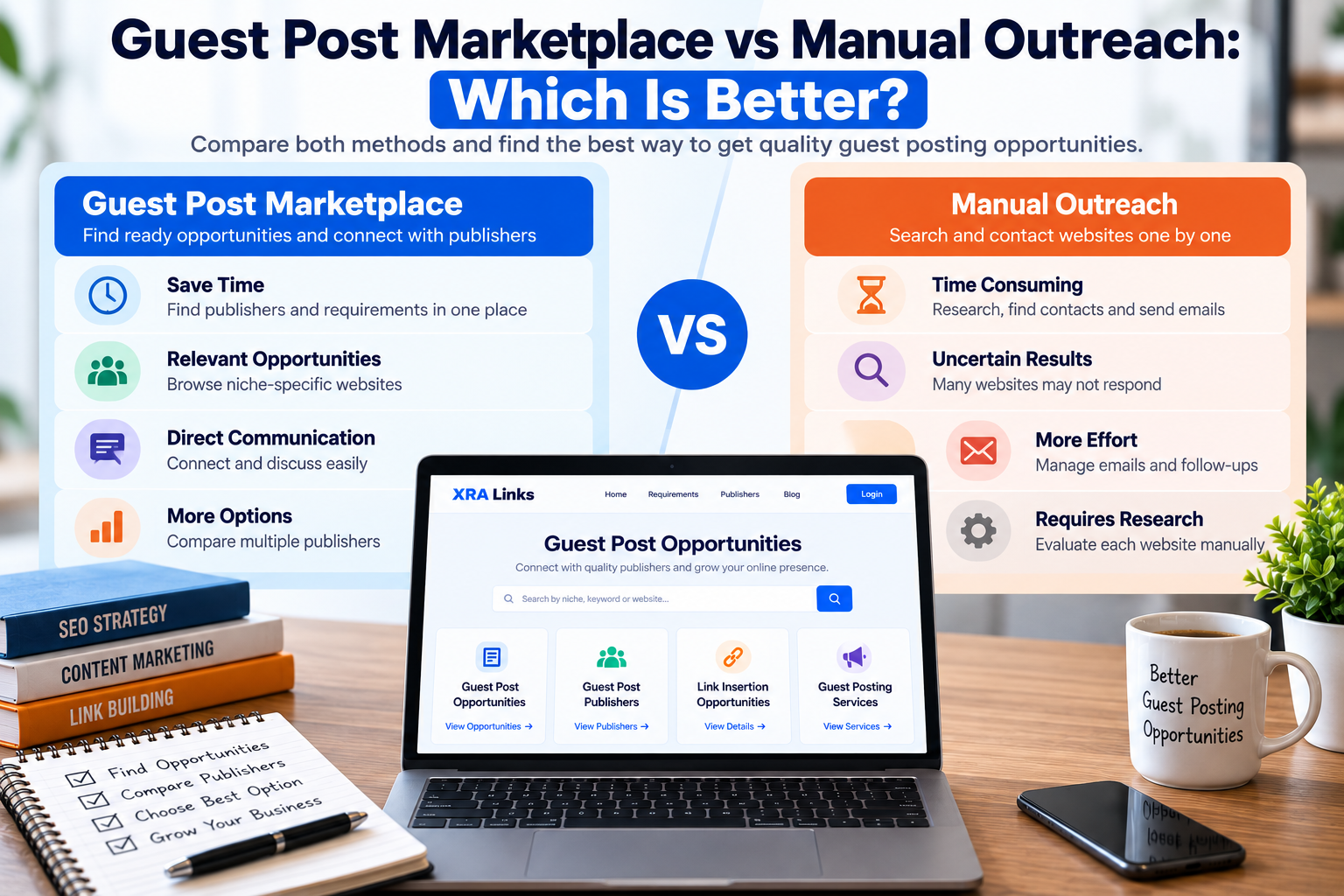
Guest Post Marketplace vs Manual Outreach: Key Differences
| FactorGuest post marketplaceManual outreach | ||
| Finding publishers | Discover opportunities through a shared platform | Research websites individually |
| Initial research | May reduce repetitive discovery work | Requires more independent research |
| Communication | Depends on the platform's features | Usually handled through email or direct contact |
| Website selection | Based on available listings and requirements | Can be highly customized |
| Pricing | May make comparing offers easier | Requires individual enquiries and negotiation |
| Relationship building | Can help start new publisher relationships | Allows direct, personalized relationship building |
| Control | Depends on platform features and rules | Greater control over the outreach process |
| Quality checks | Still necessary | Still necessary |
Neither approach is automatically better in every situation. The important question is which one helps you find relevant publishers with the least unnecessary effort.
1. Which Method Saves More Time?
Time is often the first consideration for agencies and businesses managing multiple guest posting campaigns.
With manual outreach, you may need to repeat several steps for every website:
- Find a potentially relevant publication.
- Check its niche and content quality.
- Search for contact information.
- Prepare and send a message.
- Follow up and record the response.
- Discuss the terms and publication requirements.
Some websites respond quickly, while others never reply. You may also discover that a website is no longer accepting contributions after spending time researching it.
A marketplace can reduce some of this initial discovery work by bringing buyers and publishers into a shared environment. If the platform includes relevant requirements or publisher information, you can start with opportunities that appear closer to your needs.
However, time savings depend on the platform and the available listings. You still need to check relevance, verify details, and agree on the terms.
Best fit: A marketplace can be convenient when you need to discover multiple opportunities. Manual outreach remains useful when you want to target a carefully selected list of specific publications.
2. Which Method Offers More Control?
Manual outreach gives you direct control over the websites you approach. You can research publications deeply, contact editors personally, and propose topics tailored to their audiences.
This can be particularly useful for specialist industries where only a small number of publications are suitable.
A marketplace works differently. You explore the opportunities available through the platform and evaluate them against your requirements. The range of choices depends on the participating publishers and the platform's features.
Neither method removes the need for careful evaluation.
Before agreeing to a placement, review the website's recent articles, audience relevance, organic visibility, outbound links, and editorial standards. Ask for clarification if any important information is missing.
Best fit: Manual outreach may suit highly specialized campaigns. A marketplace may suit buyers who want a more organized way to discover and compare available opportunities.
3. How Do Pricing and Negotiations Compare?
Guest post pricing varies according to the publication, niche, editorial workload, content requirements, and placement terms.
With manual outreach, you generally contact each publisher to ask about pricing. This gives you an opportunity to discuss the terms directly, although it can take time to collect and compare responses.
A marketplace may make the process more convenient if publishers share their requirements and offers in a consistent format. You can then focus on whether an opportunity fits your budget and campaign.
When comparing prices, look beyond the quoted amount. Check whether the offer includes content creation, editing, revisions, and publication. Confirm the expected turnaround time and whether the publisher has any restrictions on external links.
Do not assume that the most expensive website will produce the best results. Equally, an unusually cheap placement deserves closer scrutiny if the site's relevance or editorial quality is unclear.
For paid placements, follow appropriate advertising disclosure requirements and Google's link qualification guidance. Paying for links intended to manipulate search rankings can violate Google's spam policies.
4. Which Method Is Better for Finding Niche-Relevant Websites?
Relevance should be a priority regardless of how you find a publisher.
Suppose you manage SEO for a company that sells accounting software. A business technology publication or a small-business finance blog may be more appropriate than a general entertainment website, even if the latter has stronger third-party SEO metrics.
Manual outreach allows you to search for very specific publications and assess their content before making contact.
A marketplace can help you discover publishers or requirements that match a particular niche, provided suitable opportunities are available.
In either case, review the website itself. Read recent articles and ask whether your proposed contribution would be useful to its readers.
Metrics such as Domain Authority and Domain Rating can help with comparisons, but they are third-party measurements rather than direct Google ranking factors. They should not replace a review of content quality, relevance, and audience fit.
Best fit: Use whichever method gives you access to genuinely relevant websites. The discovery method matters less than the quality of the final selection.
5. What About Building Long-Term Publisher Relationships?
Manual outreach can be particularly effective for relationship building because you communicate directly with editors and website owners. Personalized pitches and useful contributions may lead to future collaborations.
Marketplaces can also help you establish new contacts. After discovering a suitable publisher, you can discuss requirements, clarify expectations, and determine whether working together makes sense.
In both cases, professional communication matters.
Provide clear article proposals, respect editorial guidelines, meet agreed deadlines, and avoid making promises you cannot keep. Record the details of previous collaborations so that future conversations are easier to manage.
A marketplace can help with discovery, while a good working relationship depends on the people involved and the quality of the collaboration.
6. Is a Guest Post Marketplace Safe to Use?
A marketplace can make it easier to find opportunities, but buyers should not assume that every listing is suitable simply because it appears on a platform.
Before accepting an offer, consider the following checks:
- Website ownership: Confirm that the publisher controls the website or is authorized to arrange publication.
- Content quality: Review recent articles for originality, usefulness, and editorial consistency.
- Niche relevance: Check whether the site covers topics related to your audience.
- Traffic information: Understand whether reported figures come from verified analytics or third-party estimates.
- Link policies: Review how external links are handled, including paid links and sponsored content.
- Commercial terms: Confirm pricing, deliverables, revisions, and publication expectations before committing.
Google's spam policies prohibit link schemes intended to manipulate search rankings. Paid links should be qualified appropriately, commonly with rel="sponsored" or rel="nofollow".
These checks apply to marketplace listings and publishers found through manual outreach. Neither method is a substitute for due diligence.
7. How XRA Links Can Help Buyers and Publishers
XRA Links provides a community for people involved in guest posting and link building.
For buyers, the platform offers a place to share requirements and discover publishers who may be able to meet them. This can help organize the search process and reduce the need to begin every discovery task independently.
For publishers, it provides a place to review requirements shared by potential buyers and respond when the requested niche, content, and commercial terms are a good fit.
Depending on your role, these pages are useful starting points:
- Guest post opportunities for buyers exploring potential placements.
- Guest post publishers for people looking to connect with publishers.
- Guest posting services for exploring guest posting options.
- Link insertion opportunities for existing-content placement opportunities.
- Browse requirements to explore requests shared through the community.
The platform is best treated as a discovery and connection resource. Buyers should still verify websites and agree on all terms before proceeding.
Should You Use a Marketplace, Manual Outreach, or Both?
For many SEO professionals, combining the two methods is a practical option.
You can use a marketplace to discover opportunities and understand current requirements, while continuing to build direct relationships with publications that are especially relevant to your clients.
A simple approach looks like this:
- Define your target niche, audience, and budget.
- Explore relevant requirements and publisher opportunities.
- Identify additional publications through manual research.
- Evaluate each website using consistent quality criteria.
- Compare terms and communicate with suitable publishers.
- Track your outreach, published articles, and campaign outcomes.
This approach gives you more than one source of opportunities without sacrificing the quality checks that matter.
If you work with a very narrow niche, manual research may remain an important part of the process. If you need to discover publishers across several industries, a marketplace may help organize that work.
The best choice is the one that supports your workflow while keeping relevance, editorial quality, and transparency at the center.
Frequently Asked Questions
Is a guest post marketplace better than manual outreach?
It depends on your needs. A marketplace can help organize discovery and connect buyers with publishers, while manual outreach offers direct control over prospecting and communication. Many professionals benefit from using both.
Can I find free guest posting opportunities?
Yes. Some websites accept relevant editorial contributions without charging a placement fee. Search for contributor guidelines and submission pages, and confirm the publisher's current terms before preparing an article.
Do guest post marketplaces guarantee backlinks?
You should not assume that a listing guarantees publication or a particular type of backlink. Confirm the deliverables and link attributes with the publisher before agreeing to a placement. No method guarantees ranking improvements.
How do I choose a reliable guest post publisher?
Review the website's niche, content quality, organic visibility, editorial standards, and outbound links. Verify the publisher's authority to arrange publication and clarify the commercial terms.
Can small SEO agencies benefit from a marketplace?
Potentially, yes. Agencies can use marketplaces to discover publishers and requirements while continuing to research specialist websites independently. The value depends on whether the available opportunities match their clients' needs.
Find Guest Posting Opportunities With XRA Links
Manual outreach and guest post marketplaces both have a place in a sensible publishing strategy. Manual research gives you direct control over prospecting, while a marketplace can offer a more organized way to discover potential publishers and buyer requirements.
Whichever method you choose, prioritize relevant websites, useful content, transparent agreements, and responsible link practices.
Visit XRA Links to explore guest posting opportunities, connect with publishers, and share your requirements. You can start with the guest post opportunities page and find opportunities that fit your campaign.