Finding guest post opportunities can be time-consuming when you rely only on Google searches, spreadsheets, and cold emails. You may find websites that accept guest contributions, but that does not necessarily mean they are relevant to your audience, currently accepting submissions, or a good fit for your content.
A better approach is to focus on websites that publish useful content in your niche, identify the right person to contact, and evaluate each opportunity before investing time or money.
Whether you are an SEO professional, a business owner, a digital marketing agency, or a website publisher, this guide explains how to find guest post opportunities and build a more organized outreach process.
What Are Guest Post Opportunities?
Guest post opportunities are chances to contribute an article to another website. The article is usually written by an external contributor and published for the host website's audience.
For example, a web development agency might contribute an article about website maintenance to a business technology blog. A marketing consultant could write about content planning for a digital marketing publication.
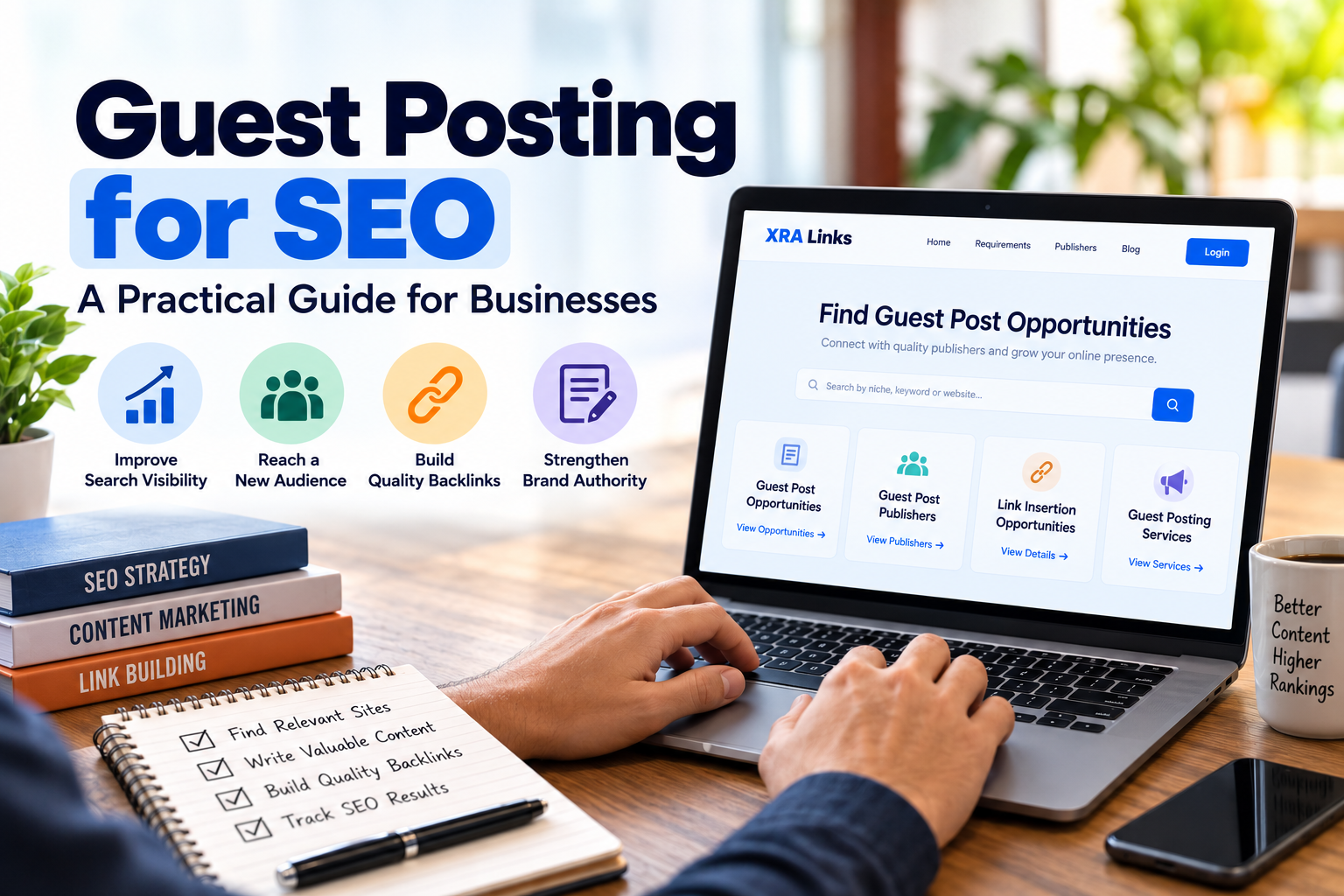
Guest posting can help you reach a new audience, demonstrate your knowledge, build relationships with publishers, and earn referral traffic. Depending on the publication and its editorial policy, an article may also include an author bio or a relevant link to your website.
The important point is relevance. A guest post on a website that serves your intended audience is generally more useful than a placement on an unrelated site chosen only because it offers a backlink.
1. Start With Your Niche and Target Audience
Before searching for guest posting websites, decide which audience you want to reach.
A broad niche such as digital marketing can include SEO, paid advertising, content marketing, email marketing, and social media. Each of these areas has its own audience and publications.
Start by listing three things:
- Your main industry or niche.
- The topics your target audience regularly reads about.
- The types of websites that publish those topics.
For example, if you run a web development company, you might target web design blogs, SaaS publications, technology websites, and small business resources.
If you operate an ecommerce business, relevant opportunities could include ecommerce blogs, retail publications, online business communities, and product-focused websites.
This initial research helps you avoid wasting time on websites that have little connection to your business.
2. Use Google Search Operators to Discover Guest Posting Websites
Google remains a useful starting point for finding websites that accept contributions. Instead of searching for a broad phrase such as "guest posting sites," use specific queries related to your niche.
Here are some examples you can adapt.
| Search queryWhat it helps you find | |
your niche + "write for us" | Contributor guidelines and submission pages |
your niche + "guest post" | Articles and websites discussing guest contributions |
your niche + "guest article" | Websites using alternative terminology |
your niche + "contribute" | Publications inviting outside contributors |
your niche + "submit an article" | Article submission instructions |
your niche + "become a contributor" | Contributor or author programs |
Replace "your niche" with a specific topic.
For example, searches such as web development "write for us" or ecommerce "become a contributor" can help uncover relevant websites.
You can also search for topics your audience cares about instead of focusing exclusively on guest post terminology. Some publishers accept outside contributors without advertising a formal guest posting program.
One thing to remember: A page inviting contributors does not automatically mean the publisher is accepting submissions today. Check the latest guidelines and confirm the terms before preparing an article.
3. Research Competitors and Their Published Guest Posts
Competitor research can reveal websites that already publish content about your industry.
Start by identifying businesses, agencies, or professionals that target a similar audience. Review their blogs, author biographies, and external publications to see where they have contributed content.
Look for signs such as:
- Articles written by guest authors.
- Contributor biographies linking to another website.
- Author pages on industry publications.
- Editorial pages describing external contributor programs.
- Interviews, expert roundups, and collaborative articles.
You can also search for a competitor's name alongside phrases such as "guest author," "contributor," or "published on."
Do not assume that every external mention is a guest post. Some are interviews, press coverage, sponsored articles, or other forms of collaboration. Identify the actual format before adding a website to your prospect list.
Once you discover a potential publisher, check whether its audience, editorial standards, and contribution terms match your goals.
4. Evaluate Website Quality Before Contacting a Publisher
Finding a long list of websites is easy. Identifying the ones worth approaching takes more care.
A website can have attractive SEO metrics and still be a poor choice if it publishes unrelated articles, has little genuine readership, or exists mainly to sell links.
Before contacting a publisher, review the following factors.
Topical relevance
Does the website regularly publish content related to your niche? Read several recent articles rather than judging relevance from the homepage alone.
Content quality
Check whether articles offer useful information, are edited properly, and provide a good reading experience. Look for original insights rather than pages filled with generic content.
Organic visibility
Where appropriate, review the website's estimated organic traffic, ranking keywords, and visibility trends using SEO tools. Treat third-party estimates as directional rather than exact figures.
Audience and engagement
Consider whether the website appears to serve a real audience. Relevant comments, active readership signals, branded searches, and useful content can provide context, although no single signal proves a site's quality.
Outbound links
Review how the website links to external pages. If most articles contain numerous unrelated commercial links, investigate further before proceeding.
Editorial guidelines
Check whether the publisher accepts your topic, allows relevant references, and explains any restrictions on promotional content or external links.
Domain Authority (DA) and Domain Rating (DR) can help with initial comparisons, but neither metric is a direct Google ranking factor. Do not select a website based on one number alone.
5. Connect With Guest Post Publishers More Efficiently
Once you have identified suitable websites, the next challenge is reaching the people who manage them.
You can find publisher contact details through contributor pages, editorial contact pages, author profiles, or professional networking platforms. When sending an inquiry, explain why your proposed topic fits the publication.
A short, relevant message is usually more useful than a generic email sent to hundreds of websites.
For example:
"Hello, I came across your website while researching resources about ecommerce. I would like to contribute an original article on improving product page usability. Would you be open to reviewing a topic proposal? I can share an outline and writing samples if helpful."
Adapt the message to each publisher. Mention a specific article or topic that shows you understand the publication's audience.
If you need to contact multiple publishers, maintain a spreadsheet with website URLs, niches, contact details, submission requirements, quoted prices where applicable, and follow-up dates.
This makes it easier to track conversations and avoid contacting the same publisher repeatedly.
6. Use a Guest Posting Marketplace to Discover Opportunities
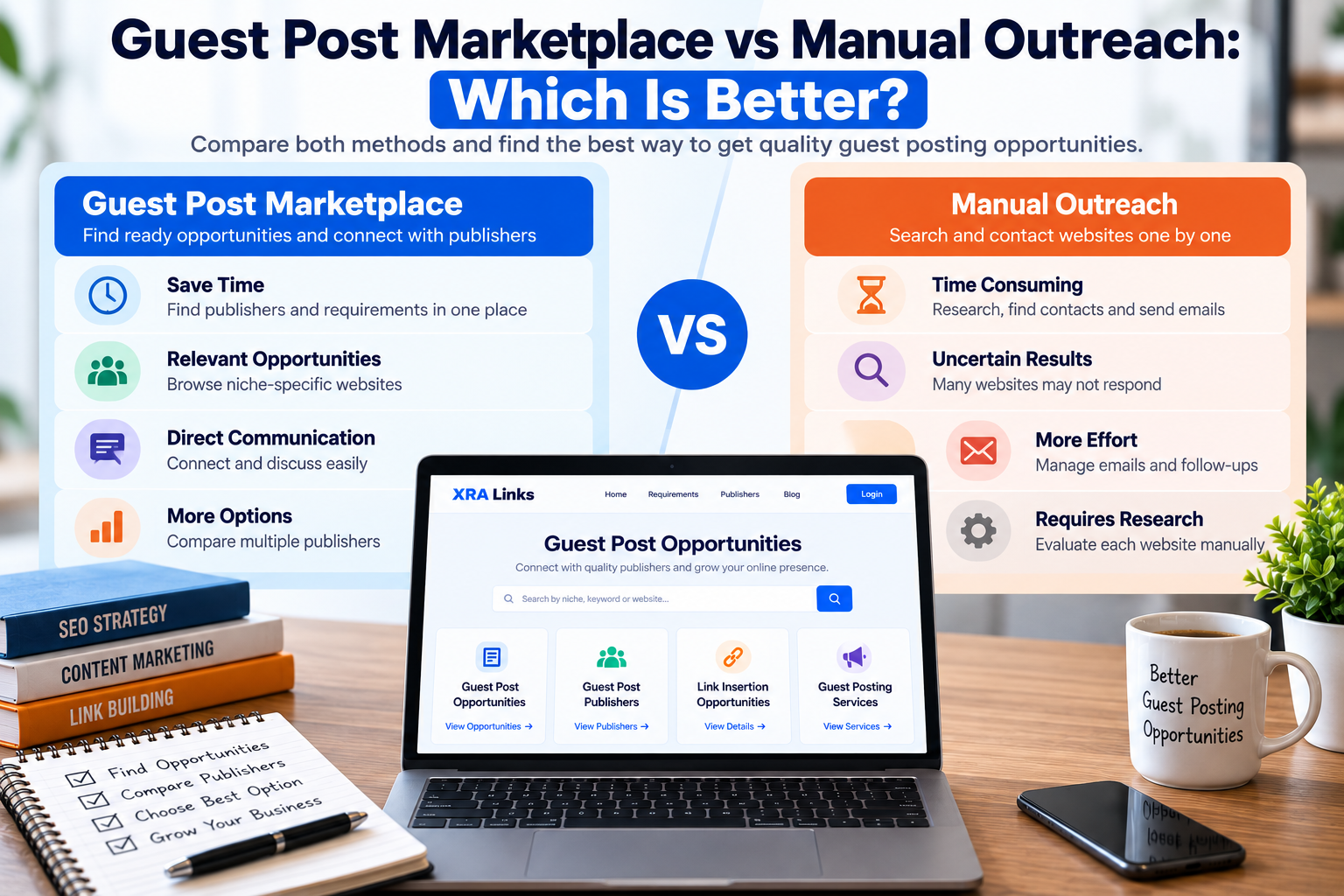
Manual research works, but it can involve a lot of repetitive tasks. You may spend hours finding websites, locating contact details, sending emails, and waiting for replies.
A guest posting marketplace or community offers another way to discover opportunities. Instead of approaching every website individually, you can look for publishers and requirements already shared by people working in the industry.
XRA Links provides a platform where buyers can share guest posting or link-building requirements and publishers can respond with relevant offers. This gives both sides a place to discover opportunities and start a conversation.
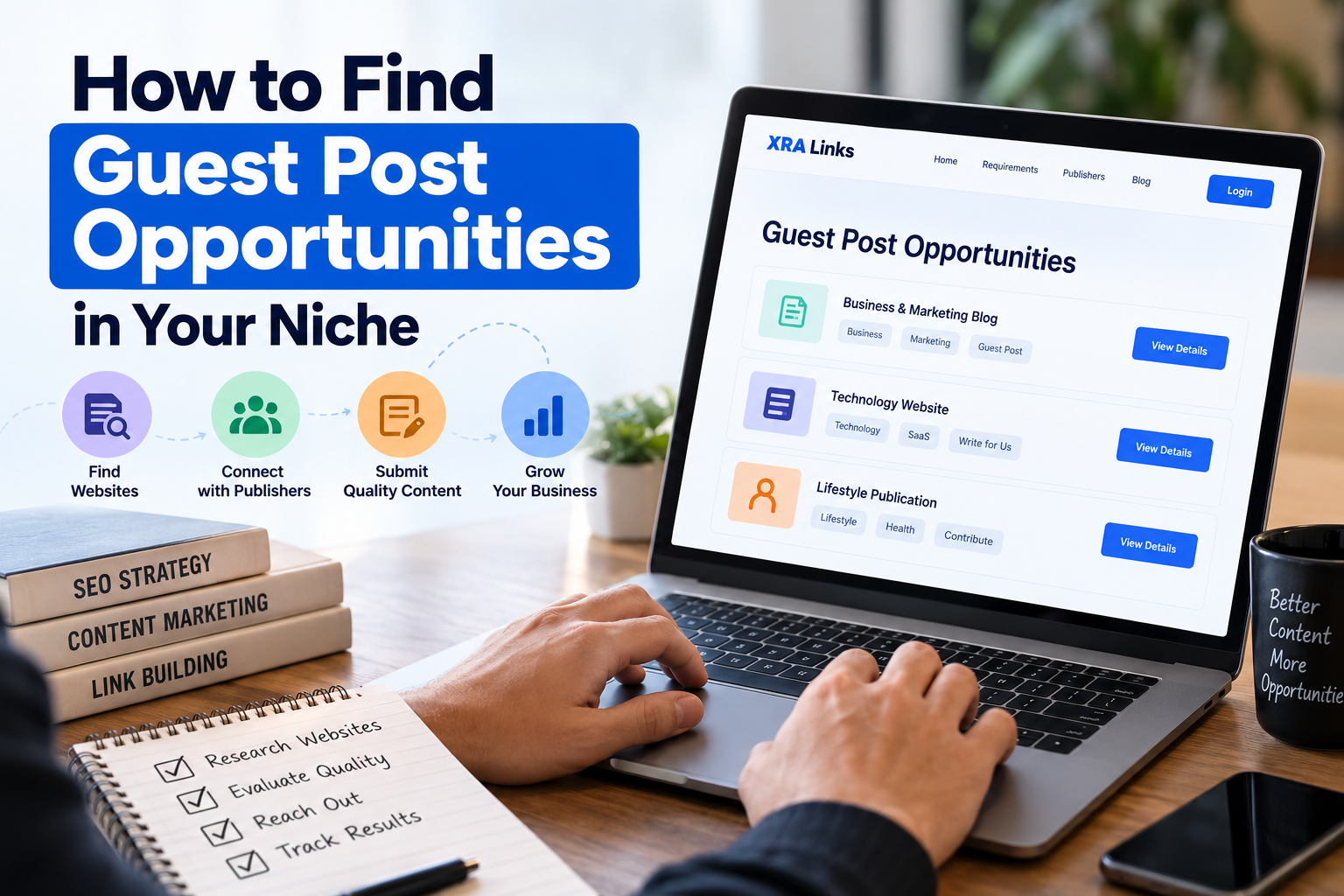
You can explore the guest post opportunities on XRA Links to find relevant requirements. If you offer publishing services, the guest post publishers page is another useful starting point.
Businesses looking for placements can also explore guest posting services, while those seeking existing-content placement options can review link insertion opportunities.
The benefit of this approach is organization. You can focus on requirements and publishers that appear relevant instead of starting every search from scratch.
Still, a marketplace does not remove the need for due diligence. Review each website, confirm the publisher's terms, and evaluate whether the opportunity makes sense for your audience.
7. Write a Clear Guest Post Requirement
If you are a buyer looking for publishers, a clear requirement can help you receive more relevant responses.
Instead of posting "Need guest posts, send sites," explain what you need and what makes a website suitable.
Include details such as:
- Your target niche or industry.
- The preferred website audience and country, if relevant.
- Minimum traffic or authority criteria, if you use them.
- Your budget or expected price range.
- Whether you need a new guest post or an existing-content link insertion.
- Your content requirements and preferred turnaround time.
For example, an ecommerce company might request websites covering online retail, product marketing, or business technology. It could also specify that websites should have relevant organic visibility and accept original, editorially appropriate content.
Avoid setting arbitrary requirements that do not serve your actual goals. A smaller, highly relevant publication may be more valuable to your audience than a larger website covering unrelated topics.
You can review the requirements section on XRA Links to explore the community's approach to sharing opportunities.
8. Understand Guest Post Pricing Before Committing
Guest posting prices vary considerably. Publishers may consider their audience, editorial workload, niche, content requirements, and placement terms when setting a price.
Some websites accept well-written editorial contributions without a placement fee. Others charge for sponsored content or offer separate rates for article creation, publication, and link insertion.
When comparing offers, check exactly what is included.
Ask whether the price covers writing, editing, publication, revisions, and any additional services. Confirm how long the article will remain published and whether the publisher has restrictions on links.
Do not assume that a higher price guarantees better results. Likewise, an unusually low price may warrant closer scrutiny if the website has little topical relevance or unclear publishing standards.
For sponsored placements, make sure the publisher follows applicable advertising disclosure requirements and Google's link qualification guidance. Paid links intended to manipulate search rankings can violate Google's spam policies. Qualifying paid links with rel="sponsored" or rel="nofollow" is an important part of handling them appropriately.
The aim should be to find relevant publishing opportunities that provide genuine audience or business value, not simply to purchase a ranking signal.
9. Track Your Guest Posting Outreach
As your list of prospects grows, tracking becomes increasingly important.
Create a simple spreadsheet or CRM with fields for the website name, URL, niche, contact person, submission guidelines, date contacted, response status, quoted price, and next action.
You can also record whether the website was approved, rejected, or placed on hold. This helps you identify which types of publishers respond most often and where your outreach needs improvement.
Review your results periodically. If many websites reject your proposals because the topics are irrelevant, refine your targeting. If publishers respond but the quoted prices exceed your budget, adjust your selection criteria or negotiate the scope of the work.
Over time, this process can turn guest posting from an unstructured search into a more manageable part of your content marketing strategy.
10. Avoid Common Guest Posting Mistakes
A few mistakes can make guest posting less effective.
Choosing websites only for DA or DR: These metrics are useful for comparison, but they do not replace checks for relevance, content quality, or real audience value.
Sending generic pitches: Publishers are more likely to understand a proposal when it clearly fits their publication and audience.
Ignoring editorial policies: Review submission requirements, link rules, sponsored content terms, and content standards before agreeing to a placement.
Buying links solely to manipulate rankings: Google's spam policies restrict link schemes intended to influence search rankings. Focus on editorial value, and qualify paid links appropriately.
Failing to verify the publisher: Confirm that the person offering a placement controls the website or is authorized to arrange publication. Agree on the deliverables and terms in writing.
Not tracking results: Keep records of your outreach, publication status, referral traffic, and business outcomes so you can make better decisions over time.
Frequently Asked Questions
How do I find free guest post opportunities?
Search for niche-related contributor pages, use Google queries such as your niche + "write for us", and review publications that accept outside contributors. Check each website's current submission policy because some opportunities may be paid or closed to new authors.
Are guest posts good for SEO?
Guest posts can support brand visibility, referral traffic, and relationships with relevant publications. However, publishing articles primarily to obtain ranking-manipulating links can violate Google's spam policies. Prioritize useful content and legitimate editorial contributions.
How do I find guest post websites in a specific niche?
Search using your niche alongside phrases such as "write for us," "contributor guidelines," and "submit an article." Review industry publications and competitor author profiles, then assess relevance and quality before contacting the publisher.
How can website owners find guest post buyers?
Website owners can build a clear publisher profile, describe their niche and editorial standards, and connect with businesses seeking relevant publishing opportunities. A platform such as XRA Links can help publishers discover requirements shared by potential buyers.
Should I choose a website based on Domain Authority?
No. DA is a third-party metric, not a Google ranking factor. Consider topical relevance, content quality, audience fit, organic visibility, and editorial standards alongside any SEO metrics you use.
Find Your Next Guest Post Opportunity With XRA Links
Finding the right guest post opportunities takes more than collecting a list of websites. You need to understand your audience, evaluate publishers carefully, communicate clearly, and keep track of your outreach.
Start with a focused niche, build a shortlist of relevant publications, and prioritize opportunities that offer genuine value to readers. If manual outreach is taking too much time, explore a community where buyers can share requirements and publishers can respond.
Visit XRA Links to discover guest posting and link-building opportunities, connect with publishers, and share your own requirements.